
Sterilization and Infection Control in Dental Clinics: What Should You Know When Evaluating a Clinic?
Sterilization and infection control in dental clinics are two practical dimensions for evaluating how instruments and surfaces are handled and how infection transmission is reduced; they cannot be reduced to the appearance of the premises or visible cleanliness. Evaluation includes understanding instrument reprocessing and infection-control procedures related to the treatment environment, with reference to approved standards when assessing practices. Visible cleanliness or any single sign does not prove the overall level of adherence to these procedures.
Patients can observe some signs of adherence, but these alone do not reveal whether all sterilization and infection-control processes are carried out according to documented procedures and standards. Understanding these limits helps apply evaluation criteria more accurately when reviewing options in the Dental clinic directory in Saudi Arabia, starting with distinguishing among cleaning, disinfection, and sterilization of instruments.
The Difference Between Cleaning, Disinfecting, and Sterilizing Dental Instruments
Cleaning, disinfection, and sterilization are related processes, but they are not synonymous in dental instrument reprocessing. Cleaning focuses on removing soil and debris, while disinfection involves reducing or eliminating microorganisms according to the level of processing, and sterilization refers to a different level of instrument processing against microorganisms.
The three processes can be compared by their primary purpose, what they address, the level of microbial control, and their place in instrument reprocessing. This distinction explains why removing organic soil alone does not mean an instrument has been sterilized, and why the terms cleaning, disinfection, and sterilization should not be used interchangeably.
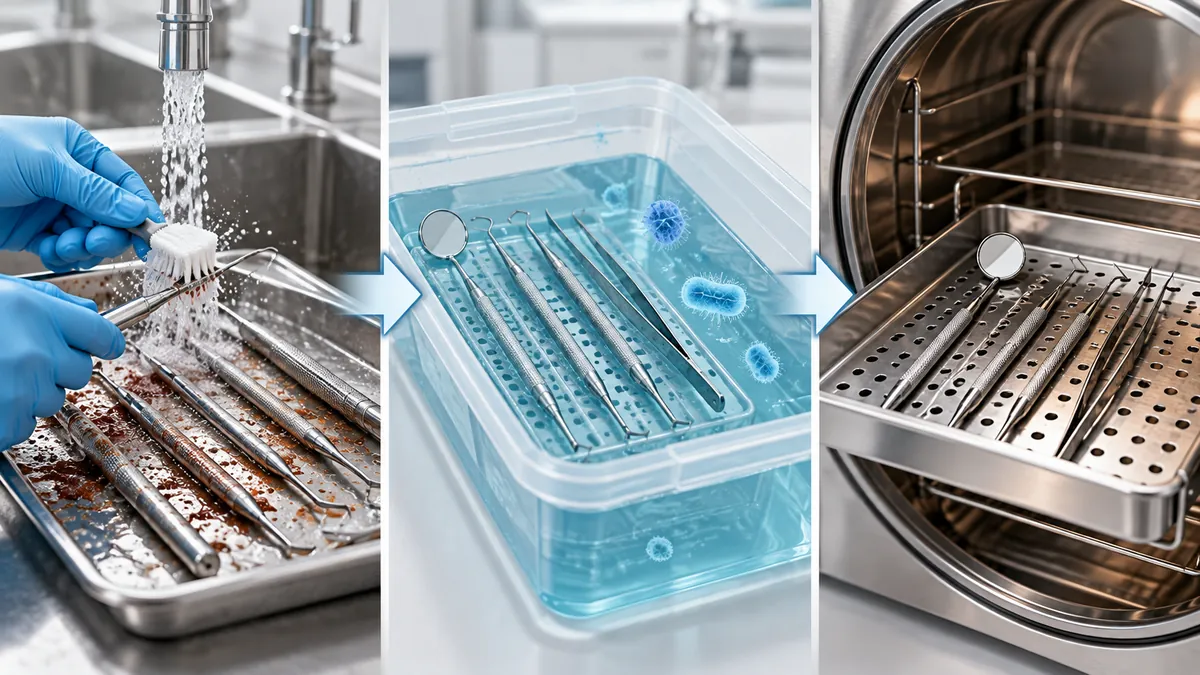
| Process | Primary purpose | What it addresses | Place in instrument reprocessing | What it does not mean on its own |
|---|---|---|---|---|
| Cleaning | Removing soil and debris | Organic soil and foreign material on instruments | Preparing dental instruments for subsequent processing | Does not mean sterilization |
| Disinfection | Reducing or eliminating microorganisms according to the level of processing | Microorganisms on instruments or surfaces, depending on the processing context | Part of processing when disinfection is the required level | Does not mean sterilization on its own |
| Sterilization | Processing instruments to the sterilization level | Microorganisms and germs targeted by the sterilization process | A stage intended for instruments that require sterilization within instrument reprocessing | Does not mean prior cleaning is unnecessary |
How Do Reusable Dental Instruments Go Through the Sterilization Process?
Reusable dental instruments pass through an organized reprocessing sequence that begins with handling after use and ends with protected storage or release for use according to the approved procedure. The order of the stages matters because later stages depend on appropriate completion of earlier processing, so sterilization is not treated as a stage separate from cleaning, inspection, and preparation.
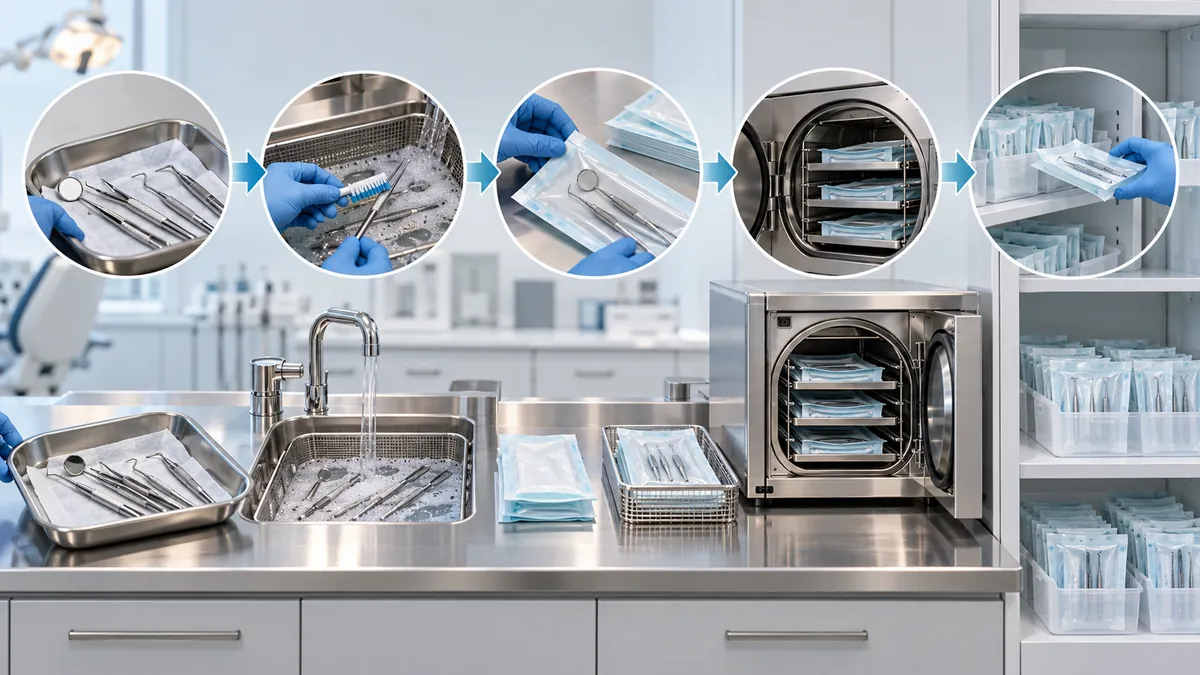
- Handling after use: Reprocessing begins with handling used instruments in preparation for moving them to the next processing stages.
- Cleaning: Instruments are cleaned to remove debris and material that could interfere with later stages.
- Inspection and preparation: Instruments are inspected after cleaning and prepared as appropriate for moving to the next stage.
- Packaging: Instruments that require packaging are prepared in suitable packages before sterilization.
- Sterilization: Instruments undergo the sterilization process according to the approved procedure appropriate for them.
- Protected storage or release for use: Processed instruments are stored under protected conditions or released for use according to the conditions of the approved procedure and package integrity, when applicable.
The exact details of reprocessing vary by instrument type and the requirements of the approved procedure, so no single operating method can be applied to all reusable dental instruments. Verification that the required stages are complete and that release-for-use conditions are met remains tied to the protocol applied to the instrument, without assuming that one stage is enough to complete the process.
Cleaning and Preparing Instruments Before Sterilization
Cleaning and preparing dental instruments before sterilization focuses on safely handling contaminated instruments, removing debris and soil, and then confirming that the instrument is ready for the next stage. Visible debris must be addressed before the instrument is considered ready for subsequent processing, because remaining debris means the cleaning stage is not yet complete.
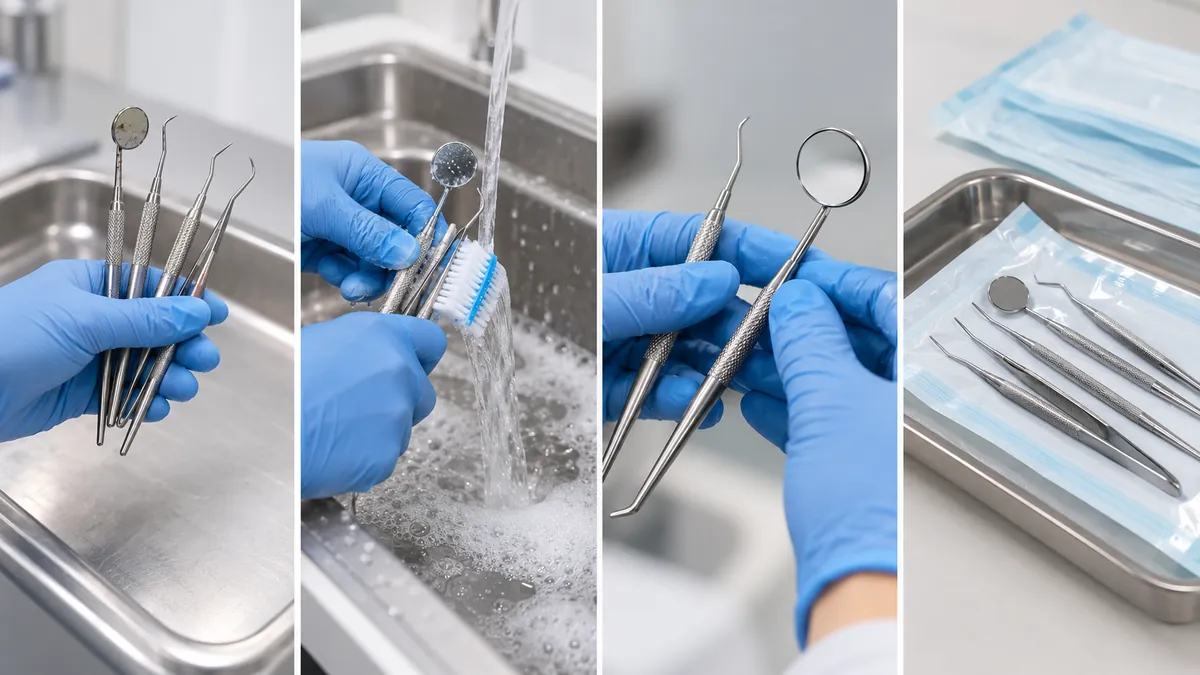
- Safe handling of contaminated instruments: Preparation before sterilization begins by handling used instruments in a way that reduces unnecessary exposure during transport and the start of processing, while keeping them within the approved cleaning pathway.
- Debris removal and cleaning: Visible debris and soil are removed from the instrument using a cleaning method suitable for it; if deposits remain, cleaning must be completed before moving to subsequent preparation.
- Rinsing and drying when applicable: Rinsing or drying is carried out when required by the instrument type and the approved cleaning procedure, so that the instrument is in a suitable condition for inspection and the next preparation step.
- Inspection: The instrument is inspected after cleaning to confirm removal of visible debris and assess its integrity and readiness for the next stage; if visible soil remains, the cleaning stage is not considered complete.
- Preparation for packaging: After cleaning and inspection are complete, the instrument is prepared for packaging according to its type and the approved procedure, without treating cleaning alone as sterilization of the instrument.
Cleaning, rinsing, drying, and preparation for packaging vary according to the instrument type and the approved procedure, so one method cannot be applied to all dental instruments. Readiness for this stage depends on completing the required debris removal, inspecting the instrument, and preparing it appropriately for packaging.
Packaging, Sterilizing, and Storing Instruments Until Use
Instrument packaging, sterilization, and protected storage are connected stages in reprocessing, but each stage has a different function. Packaging prepares the instrument for the sterilization cycle and helps maintain its processed condition after the cycle is completed, while packaging or storage does not replace the sterilization process itself.
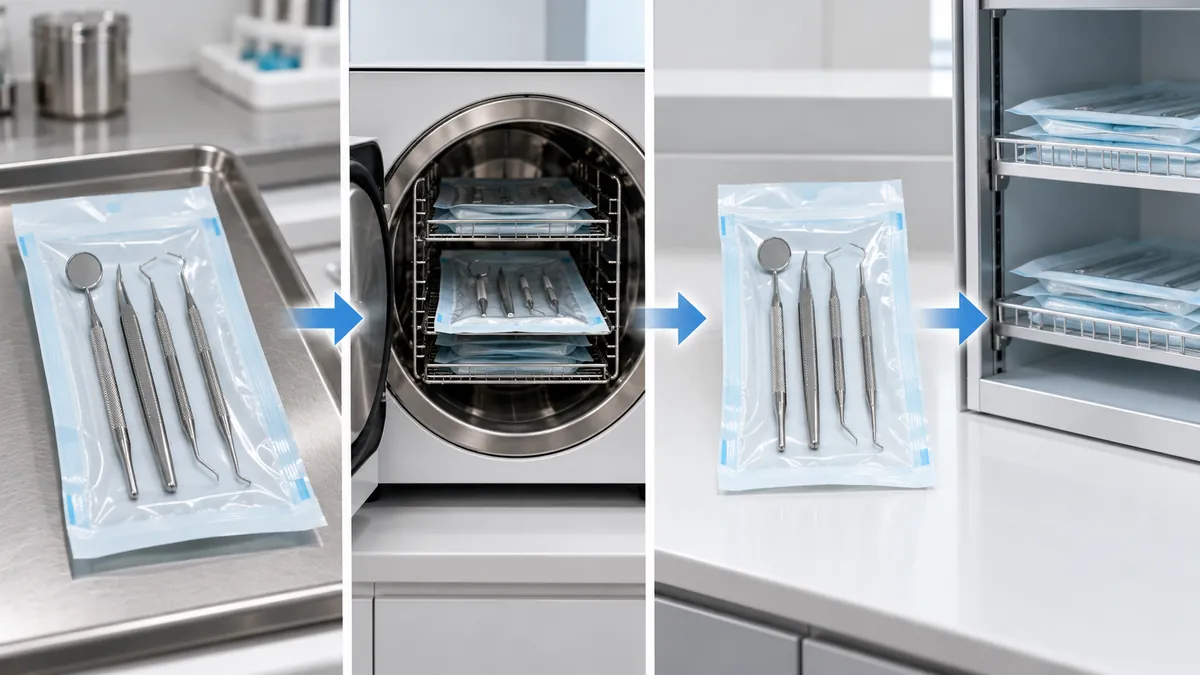
- Instrument packaging: Instruments that require packaging are placed in suitable packaging according to the approved procedure before the sterilization cycle, making packaging part of their preparation for subsequent processing.
- Sterilization: Packaged instruments undergo the sterilization cycle appropriate for them according to the approved procedure and equipment used, without assuming that one cycle or one setting is suitable for all instruments.
- Checking package integrity: After processing, package integrity and seal integrity, when applicable, are considered before storage or release for use; a damaged package does not perform the intended function of maintaining the processed condition.
- Protected storage: Processed instruments are kept under protected storage conditions according to the approved procedure until use or release for use, with continued attention to package integrity.
The details of the sterilization cycle, equipment type, release-for-use criteria, and storage conditions depend on the equipment, instrument, and approved procedures, so one operating setting or storage period cannot be applied to every case. The role of packaging and protected storage remains to help preserve the processed condition after sterilization, not to prove successful sterilization or replace the verification required within reprocessing.
How Is the Effectiveness of the Sterilization Process Monitored?
The effectiveness of the sterilization process is monitored through process-related verification evidence and its documentation, not from the appearance of instruments or their visible cleanliness alone. Sterilization monitoring includes cycle records or physical indicators, chemical indicators, and biological monitoring, with each type showing different information and having different limits of interpretation.
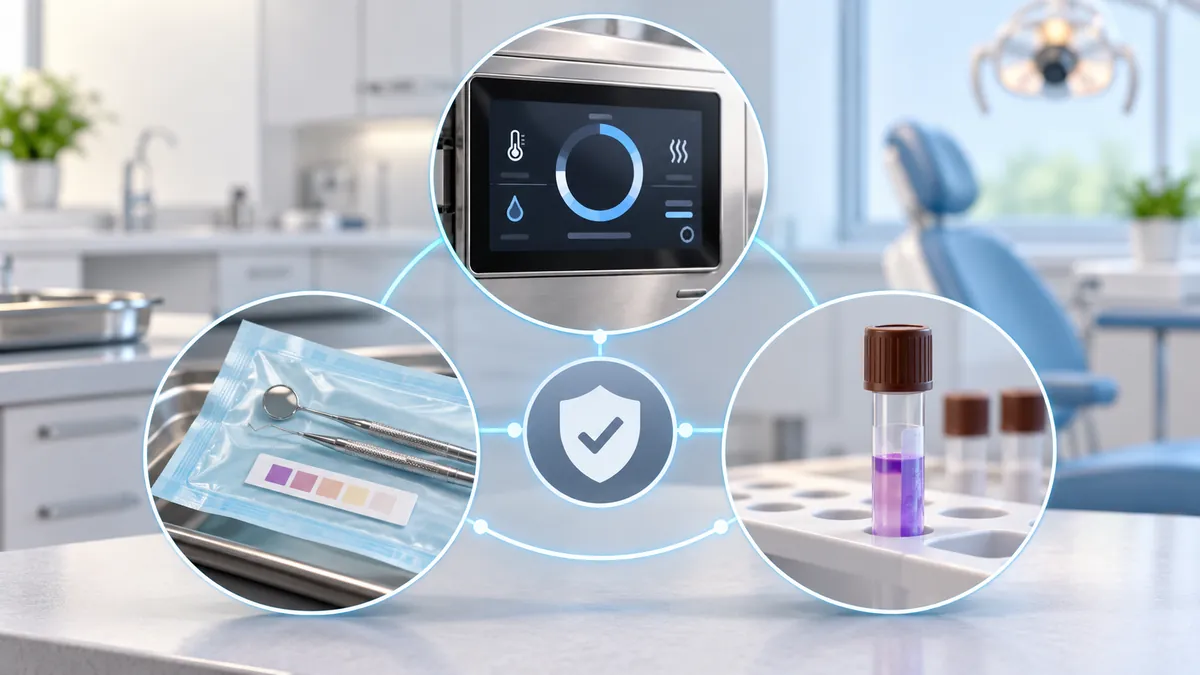
| Type of monitoring | What it monitors or records | What it can indicate | What it does not prove on its own |
|---|---|---|---|
| Cycle records or physical indicators | Cycle operating data such as time, temperature, and pressure when recorded by the device or in cycle records | Documentation of operating parameters recorded during the sterilization cycle and assistance in verifying that the process ran according to the procedure used | Does not prove on its own that all instruments became sterile |
| Chemical indicators | Exposure of the indicator on or with the package to the process conditions it was designed to respond to | The indicator response can show that the package was exposed to process conditions according to the indicator's function and method of interpretation | Does not prove on its own the full effectiveness of the sterilization process or sterilization of the package contents |
| Biological monitoring | Biological evidence used to verify the performance of the sterilization process | Provides a different type of verification evidence related to sterilization effectiveness compared with cycle records and chemical indicators | Should not be interpreted on its own, apart from the other monitoring evidence and the approved procedure |
These types of evidence have different functions: cycle records document operating parameters such as time, temperature, and pressure, while chemical indicators help interpret whether a package was exposed to the process conditions they were designed to respond to. Biological monitoring provides a different type of verification evidence related to the performance of the sterilization process. Each type is interpreted within its limits; no single piece of evidence is enough to prove the full effectiveness of the sterilization process.
The frequency of sterilization monitoring tests, the required methods, and how results are interpreted depend on current approved guidance and the procedure being applied; a fixed frequency or single requirement should not be assumed for all cases without an approved reference.
Infection-Control Procedures During Dental Treatment
Infection-control procedures during dental treatment address multiple routes of infection transmission that may connect the patient, clinical team, instruments, surfaces, and treatment environment. Exposure may involve blood, saliva, or droplets, or contact with instruments and surfaces during care. Infection control during treatment relies on coordinated controls that address these routes together, rather than on a single procedure.
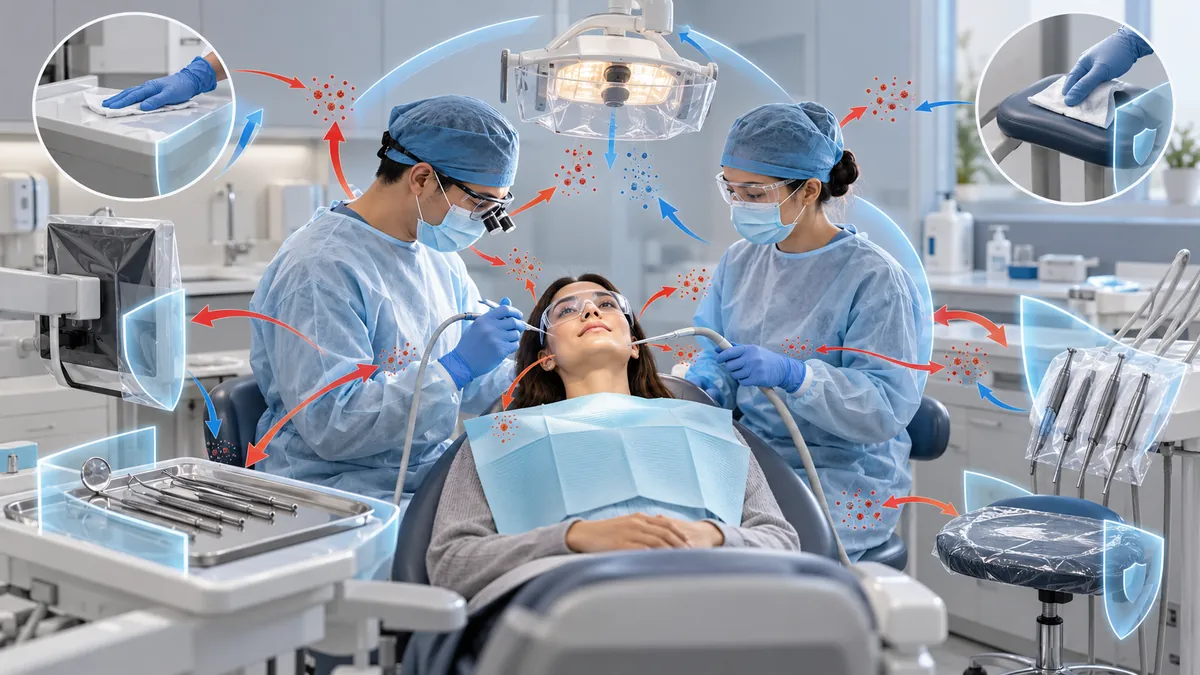
The control point varies according to the route of contamination or exposure; some controls concern the patient and clinical team, while others concern instruments, surfaces, protective equipment, and the treatment environment. Addressing these routes at the same time helps reduce contamination transfer during care.
- Blood, saliva, and droplets: Protective precautions appropriate to the expected nature of exposure are used to reduce infection transmission through these routes during treatment.
- Clinical team and exposure during care: Hand hygiene and protective equipment are linked to the exposure route and the task performed by the clinical team, so they work as integrated controls rather than treating any one of them as independent and sufficient protection.
- Instruments and contact points: Instruments are managed according to their nature and use within appropriate infection-control measures, while reducing contamination transfer through handling and treatment-related contact points.
- Surfaces and the treatment environment: Surfaces and contact areas in the treatment environment are managed according to controls appropriate to the surface and exposure, with the aim of reducing contamination transfer between care contexts.
These controls operate as parts of an interconnected infection-control system during dental treatment. No single procedure guarantees that infection will not be transmitted; appropriate controls are determined by the exposure route, the nature of the task, and the approved procedures.
Single-Use Instruments and Supplies
The designation single use for some dental instruments and supplies is determined by their intended use or the manufacturer's instructions, not merely by the instrument's appearance, material, or a clinic's decision to discard it. When an instrument or supply is intended for single use, the basic handling implication is to use it according to its instructions and then dispose of it after use through the approved method, rather than putting it into the reprocessing pathway intended for instruments that can be reprocessed.
- Supplies expressly intended for single use: They are used for one patient or one procedure according to the manufacturer's instructions and then disposed of after use according to the approved procedure.
- Instruments designated by the manufacturer for single use: How they are handled is determined by the use designation and product instructions, not by assuming they can be cleaned or reused.
- Supplies whose designation varies by product: They should not automatically be classified as single-use; the manufacturer's instructions should be consulted to determine whether they are intended for single use or can be reprocessed.
- Reusable instruments: They are not treated as single-use supplies; instead, they undergo appropriate reprocessing according to their instructions and the approved procedure before being used again.
The key distinction is that the instrument's designation determines how it must be handled and what that means for infection control: supplies intended for single use are used and then disposed of according to their instructions, while reusable instruments require reprocessing before subsequent use. This classification should not be assumed from material, appearance, or local practice alone when a reliable instrument designation is not available.
Hand Hygiene and Personal Protective Equipment Between Patients and During Treatment
Hand hygiene and personal protective equipment help interrupt contamination routes as exposure conditions change between patients and during treatment. The nature of the task and the possibility of contact with blood or saliva or exposure to droplets determine the relevant protective equipment, while hand hygiene remains a separate and complementary measure; gloves do not replace hand hygiene.
Hand hygiene and personal protective equipment work together with two different functions: hand hygiene reduces transfer of contaminants through the hands at the points of care specified in approved guidance, while protective equipment provides barriers according to the expected route of exposure.
- Moving between patients or a change in the care context: Hand hygiene is performed at the times specified in approved guidance, reducing the transfer of contamination from one care context to another.
- Possibility of hand contact with blood or saliva: Gloves form part of the personal protective equipment appropriate for this exposure, while hand hygiene remains a separate measure that gloves do not replace.
- Possibility of droplets or fluids reaching the face during treatment: A mask, eye protection, or other appropriate protective equipment is selected according to the nature of the task and expected exposure to reduce exposure of the mouth, nose, and eyes to droplets or fluids.
- Change in exposure level during treatment: The required combination of personal protective equipment changes according to the task and expected exposure route, so one set of gloves, mask, and eye protection is not treated as a fixed combination for every procedure.
The attached evidence does not specify one detailed, uniform schedule for hand hygiene timing or a single combination of personal protective equipment. Hand-hygiene points and the choice of gloves, masks, eye protection, and other equipment are determined according to the task, expected exposure, and current approved guidance.
Surface Disinfection, the Dental Unit, and Reducing Contamination Transfer
Surface and dental-unit disinfection is connected to reducing contamination transfer when surfaces around treatment are repeatedly touched or exposed to blood, saliva, or droplets during patient care. The appropriate procedure depends on the surface type and nature of exposure; it may include cleaning and disinfecting surfaces or using protective barriers in suitable locations according to the approved procedure.
Dental-unit components and waterlines need to be managed within their specific infection-control and maintenance procedures because they are not all the same type of surface or exposure route. Disinfecting a visible surface in the treatment area does not mean that all potential sources of contamination associated with the unit have been addressed.
- A treatment-contact surface exposed to touch or contamination: It is cleaned and disinfected using a method appropriate to the surface according to the approved procedure, to reduce contamination transfer between patients.
- A surface suitable for protective barriers: A protective barrier can be used to reduce contamination of the surface during treatment, with the barrier handled between patients according to the protocol in use.
- A component of the dental unit: Cleaning, disinfection, or maintenance procedures appropriate to its nature and instructions for use are applied, rather than assuming all parts of the unit are handled in the same way.
- Dental-unit waterlines: They are managed according to their specific infection-control and maintenance procedures and approved guidance; cleaning external surfaces alone should not be assumed to address the requirements associated with them.
Disinfectants, methods of use, and dental-unit and waterline maintenance requirements vary by surface, equipment, product, and current approved guidance. One disinfectant, a specific concentration, or a fixed maintenance schedule should not be applied to all clinics and equipment without reference to approved instructions and sources.
How Can a Patient Evaluate Signs of Adherence to Sterilization and Infection-Control Practices?
Patients can evaluate signs of adherence to sterilization and infection-control practices, but these signs differ in the strength of the conclusions they support. Evaluation depends on linking each criterion to its evidence source: what can be observed directly, what requires asking the clinic or reviewing documented evidence, and then defining what the sign may indicate and what it does not prove.
Signs that can be observed directly include visible cleanliness and some aspects of how instruments and the treatment area are handled, while indicators of processes that are not visible require asking the clinic or checking related documentation. Observation is useful for identifying what is visible to the patient, while asking the clinic and reviewing documented evidence provide a different basis for evaluating procedures that cannot be seen directly. Sterilization and infection-control indicators remain a specific part of Dental clinic selection criteria and do not replace the other evaluation criteria.
| Criterion | What the patient can observe or ask about | What it may indicate | What it does not prove |
|---|---|---|---|
| Visible cleanliness in the treatment area | Can be observed directly from the condition of surfaces and the treatment area visible to the patient | May indicate attention to visible cleanliness and preparation of the treatment environment | Does not prove that all sterilization and infection-control procedures are carried out |
| Visible handling of instruments used for treatment | Can be observed directly within the limits of what occurs in front of the patient | May provide an indication of how instruments are visibly handled in the treatment context | Does not prove completion of instrument reprocessing or successful sterilization |
| Sterilization procedures not visible to the patient | Requires asking the clinic or reviewing documented evidence about the process when available | May provide information on how procedures that the patient cannot directly observe are carried out | A general answer or a single piece of evidence does not by itself support an overall judgment of adherence |
| Sterilization-process monitoring and documentation | Requires asking the clinic about process evidence and the documentation used for verification | Documented evidence may indicate that a process-verification mechanism exists within the limits of the evidence shown | One type of evidence alone does not prove full adherence to all aspects of infection control |
The strength of an indicator sets the limits of its interpretation: direct observation may reveal a sign that can be assessed, while asking the clinic or reviewing documented evidence provides information about procedures the patient cannot see. A single indicator should not be treated as full confirmation of adherence or clinic safety; a more precise assessment connects the criterion, the evidence source, and what can be inferred from it without exceeding its limits.
Signs That Can Be Observed in Instrument Packaging and Treatment-Area Preparation
The condition of instrument packaging and treatment-area preparation can provide visible signs that a patient can observe, but these do not by themselves prove complete sterilization or adherence to all infection-control procedures. When reusable instruments are presented in processed packaging where applicable, the patient can observe package integrity, how the package is handled, and how it is opened for use.
- Package integrity: Observing that instrument packaging appears intact and unopened or undamaged before use may indicate that the package was maintained until the instrument was presented, but this alone does not prove that the full sterilization process was successful.
- Opening the package for use: Observing an instrument package being opened as part of treatment preparation may indicate that the packaging is being handled in line with its purpose, without revealing all earlier reprocessing stages.
- Reusable instruments: Presenting instruments in processed packaging when packaging is required for them may be one visible sign related to sterilization, but appearance alone does not allow the patient to verify or monitor the sterilization cycle.
- Treatment-area preparation: Observing that the treatment area and care-related surfaces appear prepared for the current patient may indicate that an area-preparation process is in place, but it does not prove how all cleaning and disinfection steps were performed.
- Handling between patients: Observing the treatment chair and related materials or barriers being reset between patients, when these steps are visible, may provide an indication of efforts to reduce contamination transfer without serving as full evidence of adherence.
Observing these signs can help patients ask more specific questions rather than make a final judgment from appearance alone. Package integrity, treatment-area cleanliness, or any visible change in a packaging indicator does not by itself prove that the sterilization process is complete; verification of non-visible processes remains tied to procedures, monitoring evidence, and approved documentation.
What Cannot Be Judged From Visible Cleanliness Alone?
Visible cleanliness alone cannot prove that instrument reprocessing, sterilization, sterilizer monitoring, documentation, or staff procedures were carried out correctly. It provides an observation about the visible condition of the treatment environment, but it does not reveal evidence related to processes that take place outside the patient's observation.
A patient may observe clean surfaces, an orderly treatment area, and the integrity of some packages; these are visible indicators that can be considered during evaluation. By contrast, not every step of instrument cleaning, preparation, and sterilization, or the way the sterilization process is monitored and its results recorded, can be seen from the clinic's appearance. Clean premises alone also do not show how non-visible infection-control procedures are applied or how well they are documented. Judging visible cleanliness is different from verifying process evidence.
For this reason, it may still be necessary to ask the clinic about procedures that cannot be observed directly or request clarification about available verification and documentation. Visible cleanliness should be interpreted as a limited indicator within a set of evidence, not as conclusive proof that sterilization and infection-control procedures are complete.
Questions That Help Clarify Sterilization Procedures and Infection-Control Monitoring in the Clinic
Patients can ask the clinic to clarify sterilization procedures and sterilization monitoring that cannot be verified through direct observation. The following questions help define the limits of the available information without treating one answer as full evidence of infection control.
- What can a patient ask about sterilization monitoring? The clinic can be asked about the types of monitoring evidence or documentation used to verify the sterilization process. Available information may include cycle records, chemical indicators, or biological monitoring, with each type of evidence interpreted according to its function and limits.
- What does it mean if the available sterilization-monitoring information is incomplete? It means that any conclusion should remain limited to what can be verified. The absence of some information from the patient's view does not by itself prove a problem, and the availability of a single piece of evidence does not prove that all sterilization procedures are complete.
- Can the clinic be asked how often sterilization-monitoring tests are performed? Yes. A patient can ask for clarification about monitoring frequency and the procedure followed, but a fixed frequency should not be assumed for all cases. The required frequency depends on approved guidance and the procedure being applied.
- How can a patient distinguish between single-use and reusable instruments? The distinction depends on the instrument's designation and the manufacturer's instructions, not on appearance alone. An instrument intended for single use is handled according to its instructions, while reusable instruments require appropriate reprocessing before they are used again.
- What can a patient ask about infection-control procedures that are not visible? A patient can ask for clarification about the procedure followed when it cannot be observed directly, such as how instrument reprocessing is verified or how the process is monitored. The answer should be interpreted according to the information or monitoring evidence available, without turning a general explanation into full proof of adherence.
After completing questions specific to sterilization and infection control, the review can be extended to What to check before booking without conflating those broader criteria with the evaluation of sterilization procedures themselves.
How Do Approved Infection-Control Standards in Saudi Arabia Relate to Dental Clinic Evaluation?
Approved standards and guidance in Saudi Arabia help place sterilization and infection-control procedures in a context that can be evaluated using specific evidence, rather than relying on visible cleanliness or general impressions alone. When referring to a standard or reference body, it is necessary to distinguish between what represents a mandatory requirement and what represents a recommendation or guidance framework, according to the status assigned by the approved source.
- Status of the standard or guidance: Consider the issuing body and whether the source describes it as a requirement, recommendation, or guidance, without assuming that every cited standard is mandatory.
- Scope of application: Verify that the standard relates to infection-control procedures in dental clinics and to the specific practice being evaluated, rather than applying it to every aspect of the clinic.
- Evidence of application: The clinic can be asked about procedures, records, or verification methods connected to the standard when the process cannot be observed directly.
- Limits of the conclusion: Relying on a standard or accreditation does not by itself prove facility licensing or full adherence to every requirement; licensing has a separate verification pathway with the competent authority.
The Saudi context is useful when the patient connects the relevant standard with its status, scope, and the available evidence of its application, while keeping Verifying a dental clinic license as a separate step from evaluating sterilization and infection-control procedures.