Your First Dental Clinic Visit: How to Prepare and What to Expect
A first visit to a dental clinic combines preparing for a dental appointment, understanding that what happens during the examination may differ from one person to another, and then clarifying the findings and the next step or follow-up after the examination. What takes place during the appointment depends on the reason for the visit, the information available to the dentist, and the individual situation, so there is no single set of steps that applies to every first visit.
Preparation helps you arrive at the first visit with clear information to discuss with the dentist, while the examination remains tied to the need that brought the patient in and to what becomes clear during the appointment. If you still need to choose a clinic before following these preparation guidelines, you can refer to the Dental clinic directory in Saudi Arabia.
What Should You Prepare Before Your First Appointment at a Dental Clinic?
Preparation for a first dental clinic appointment begins after the dental appointment is confirmed, by organizing useful information and following any clinic instructions you received before arriving. What you actually need to prepare depends partly on your situation and on the instructions for the appointment. Decisions that come before arranging the appointment are covered in What to check before booking a dental clinic.
Preparing for the visit does not mean reassessing the clinic or comparing it with others; it means getting ready with what can help you make use of the first appointment after choosing the clinic. This context assumes that the choice has already been made; if that decision is still pending, How to choose a dental clinic covers that stage separately.
The clinic may request specific information or administrative arrangements before you arrive, and the same requirements may not apply to every appointment. Follow the clinic instructions you were given, and ask the clinic directly if anything is unclear rather than assuming that requirements are the same for every appointment.
The following list helps you organize what may be useful before the appointment; some items are generally useful, while records or other materials should be prepared when available or when relevant to the visit.
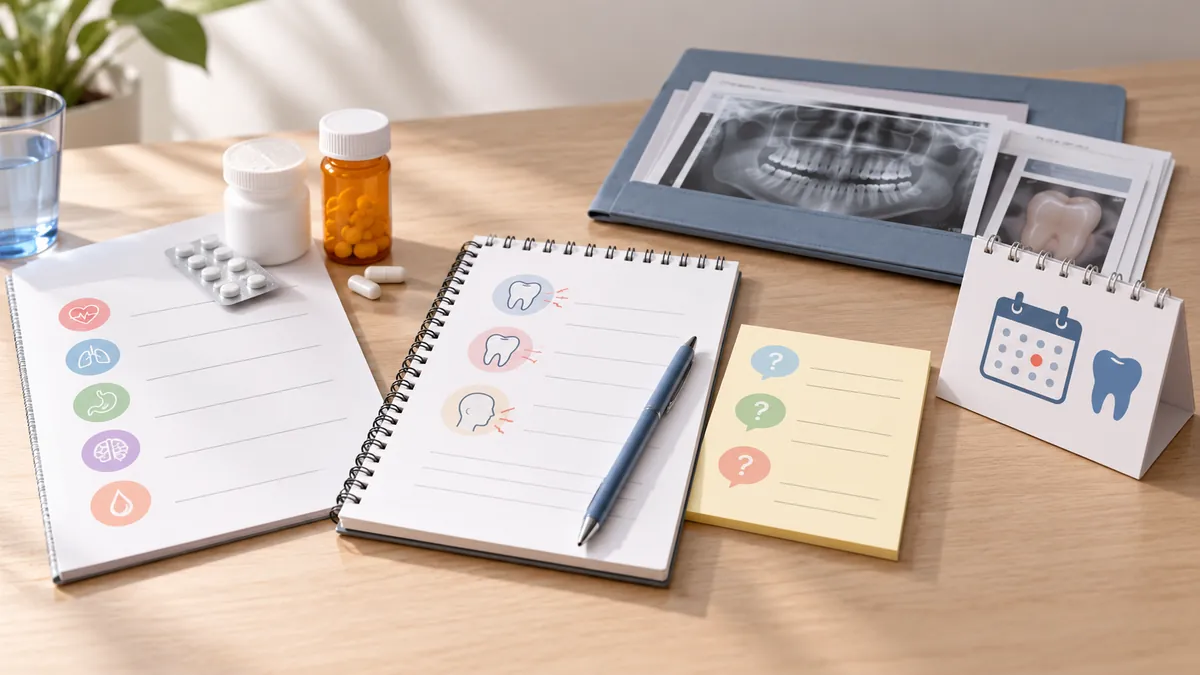
- Organize basic health-history information that may be relevant to the dental appointment.
- Prepare information about the medications you use and any known allergies so you can present it clearly when needed.
- Write brief notes about the dental problem or symptoms that led you to arrange the appointment.
- Bring previous records if they are available and related to the current problem or visit.
- Prepare previous X-rays when available and relevant to the appointment.
- Write down the questions you want to remember and discuss during the visit.
- Review the clinic instructions for your appointment and prepare any items the clinic specifically asked you to bring.
Health Information, Medications, and Allergies to Tell the Dentist About
You should accurately tell the dentist about relevant health information, including your health status, current medications, allergies, and previous reactions, because these may affect the assessment, precautions, or care planning. Presenting your health history clearly helps place this information in the context of the visit without assuming that every condition has the same effect.
The significance of health information varies by person and by what may be relevant to a planned procedure, so the patient's role is to provide the requested information accurately, not to make treatment decisions based on it. The dentist determines how relevant this information is to the assessment and precautions for the individual situation.

- Health history and health status: Clarifying relevant health conditions helps the dentist take them into account during assessment and care planning when needed.
- Current medications: Naming the medications you take allows the dentist to consider them when assessing any planning or precautions that may be relevant to your situation.
- Allergies and previous reactions: Reporting them accurately provides relevant information that can be considered as part of precautions for the visit or procedure.
- Other requested information: If the clinic asks for other relevant medical information, provide it accurately so its importance can be assessed in the context of your situation and visit.
How Should You Describe a Dental Problem and Symptoms Clearly to the Dentist?
Describe the dental problem by stating where the pain is, when the symptoms began, how long they have lasted, how they behave or recur, and what changes them. Organizing these notes helps clarify the dental complaint before the examination.
Details about the symptoms and your observations of their pattern may help guide what the dentist needs to assess during the examination, but they do not by themselves identify the cause of the problem. Your role is to describe what you notice clearly, while interpretation of that information depends on professional assessment.
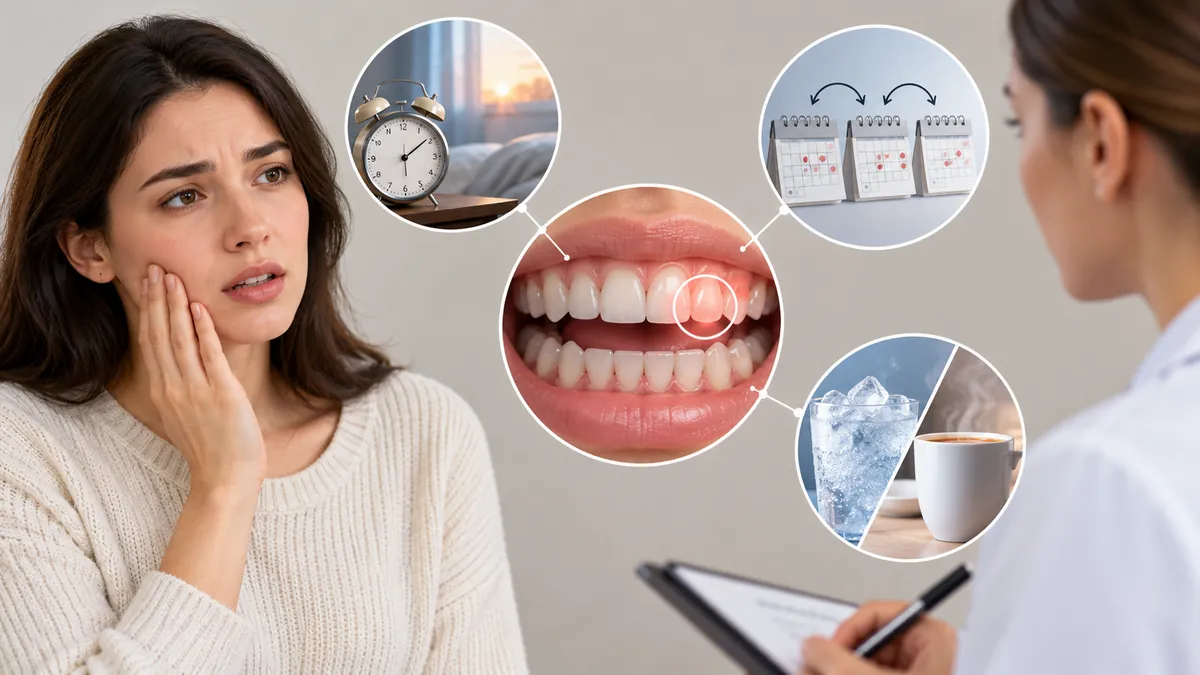
- Location of the problem: Identify the location of the problem or pain as precisely as you can observe it, such as a particular area of the mouth or a tooth that you feel is associated with the symptoms.
- Onset of symptoms: State when you first noticed the problem and whether the onset seemed sudden or gradual based on your observation.
- Duration of symptoms: Explain how long the problem has been present; if symptoms are intermittent, describe the duration or frequency of episodes as you observe them.
- Symptom pattern: Describe how the symptoms behave, such as whether they are constant or intermittent, without inferring a cause.
- Triggers: Notice whether the symptoms appear or change with a particular factor, and tell the dentist what you observed.
- Change over time: State whether the problem has remained the same or whether its pattern has changed since it began.
- Previous dental event: Mention any recent dental event that you think may be temporally related to the start of the complaint, without assuming that it caused it.
- What makes symptoms better or worse: If you notice factors that make symptoms more or less noticeable, tell the dentist about them as observations that may help clarify the context of the problem.
What Might You Need to Bring With You to the Dental Clinic?
It may be useful to have a medication list, previous records or X-rays when available and relevant to the visit, notes about symptoms and questions, and any items the clinic specifically requested; not all of these apply to every patient. Some things you bring to the dental clinic are useful for providing information, while specific requirements depend on the clinic's instructions for your appointment.
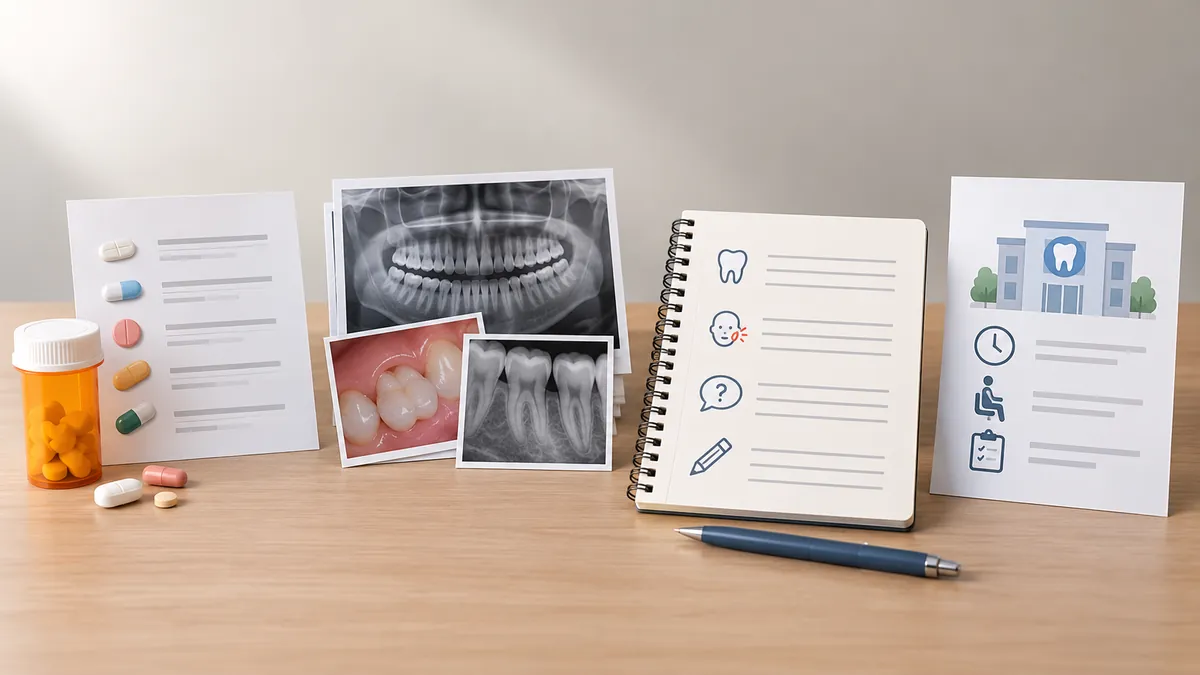
- Medication list: Keep information about your current medications available if it is relevant to the health information you will provide during the appointment.
- Symptom notes: Bring your notes about symptoms if you wrote them down so you can refer to them during the discussion.
- Questions: Keep the questions you wrote in advance so it is easier to remember what you want to discuss during the visit.
- Previous records: Bring relevant previous records when available; not having them does not mean the visit cannot take place.
- Previous X-rays: Keep previous X-rays or dental images available when they exist and are relevant to the reason for the visit.
- Items requested by the clinic: If the clinic instructions include specific requirements before you attend, follow the instructions you were given about what to bring.
Follow any specific instructions the clinic has already given you about your appointment.
How Can You Manage Anxiety or Fear About Your First Dental Clinic Visit?
The most practical step for managing anxiety about a dental visit is to tell the dental team about the anxiety or fear and agree on a simple, clear way to communicate and ask for a break. This can give the dentist and dental team a clear signal that you need an explanation or a pause during the visit.
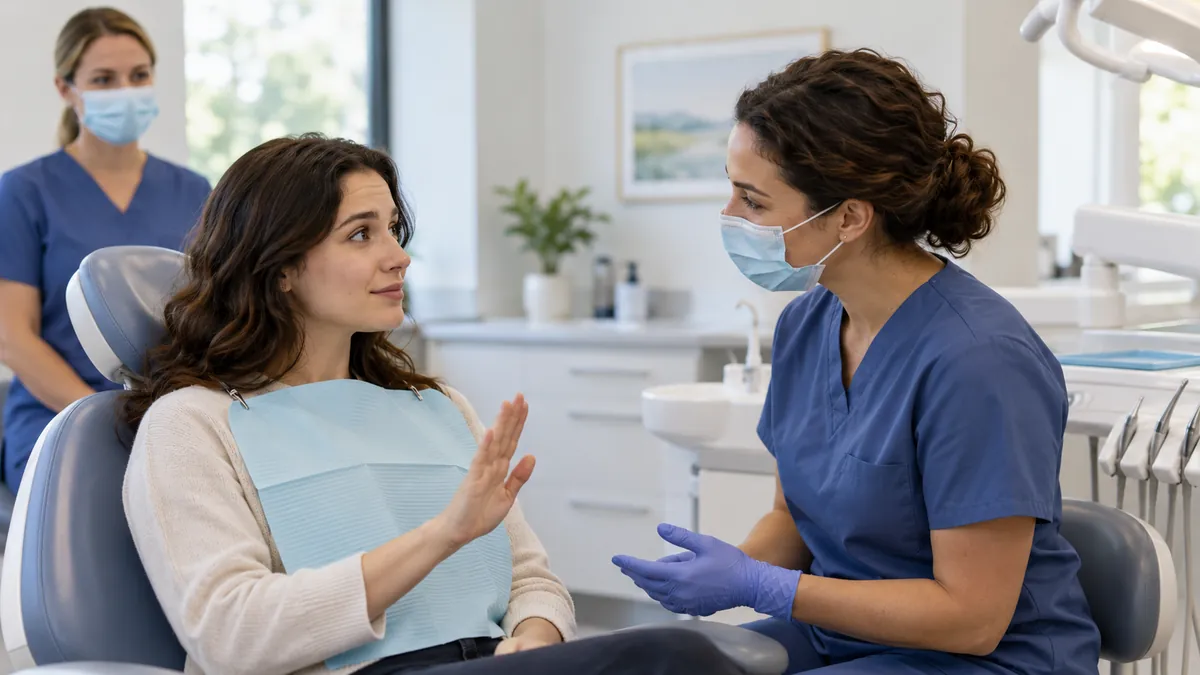
Agreeing in advance on a stop signal and asking for an explanation of what will happen before a new step begins can reduce uncertainty and keep communication clear. You can apply this during the appointment through several simple strategies whose usefulness varies from person to person:
- Tell the dental team about your anxiety: State clearly that you feel anxious or afraid about the visit so the team can take that into account when communicating with you.
- Agree on a stop signal: Choose a simple signal with the dentist that you can use when you need to stop or take a break.
- Ask for an explanation before a step begins: If not knowing what will happen increases your stress, ask for the step to be explained before moving on to it.
- Use calm breathing: Focusing on calm breathing may help some people manage stress during the appointment.
- Choose an appointment context you can manage: If there is flexibility in scheduling, choosing a time when you feel better able to manage appointment-related anxiety may help.
These strategies do not affect everyone in the same way, and using them does not mean the fear will necessarily go away. The practical goal is to keep communication clear and give you an agreed way to ask for a pause or break when needed.
What Usually Happens During a First Dental Clinic Visit?
A first dental clinic visit usually includes discussing the reason for the visit and health history, followed by a clinical examination; dental X-rays may be used when needed, after which the findings and the next step are explained. The order and components of these stages can vary from one visit to another.
The actual sequence depends on the reason for the visit, available previous records, age, what appears during the clinical examination, and the clinic's workflow. The visit may lead to discussion of appropriate care or treatment options based on the findings; the broader range of what clinics may provide is covered under Dental clinic services.
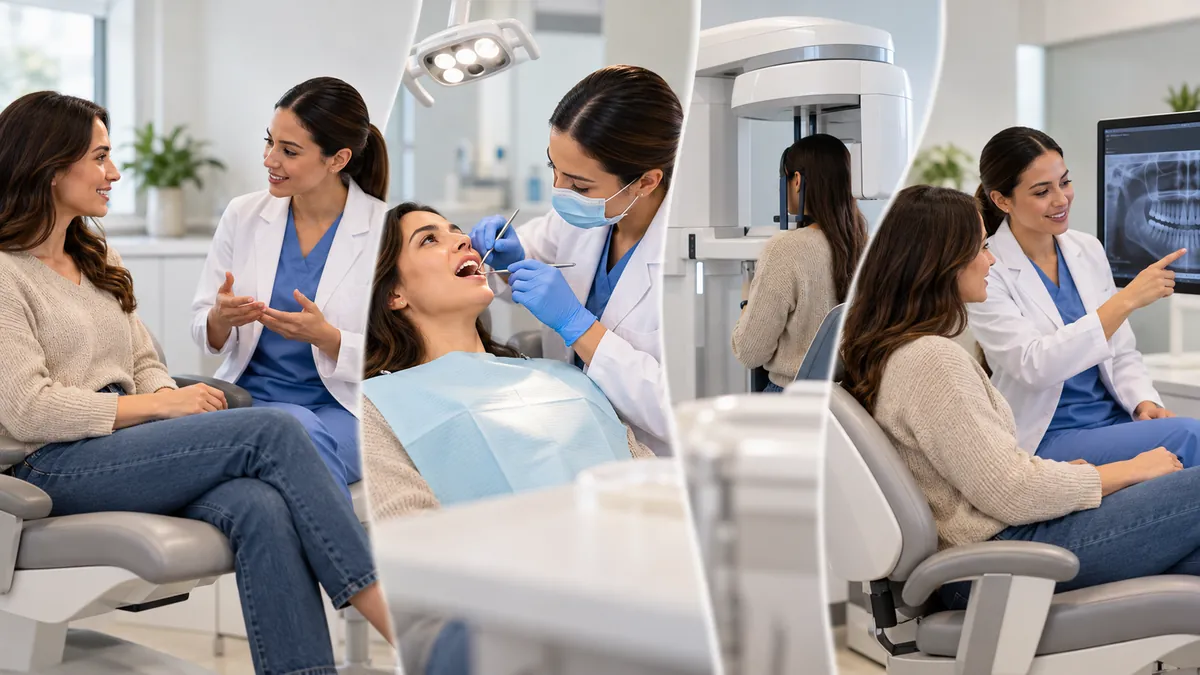
- Discussing the reason for the visit and health history: The appointment usually begins with a review of the reason for the visit and relevant health information.
- Clinical examination: The dentist examines the mouth and teeth according to what needs to be assessed during the visit.
- Dental X-rays when needed: X-rays may be used when the dentist considers them necessary to complete the assessment; they are not a required step in every first visit.
- Explanation of findings: The dentist explains what the examination showed and any related findings that are available.
- Discussion of the next step: Follow-up or appropriate care is discussed based on what the assessment shows and the individual situation.
Discussing the Reason for the Visit and Health History Before the Examination
Discussing the reason for the visit and health history is a stage for gathering information during the appointment before the examination or alongside it; the dentist clarifies the main complaint and symptoms and reviews relevant health information, including medications and allergies, as well as previous care or dental history. The purpose of this discussion is to understand the context of the problem and information that may be relevant to the assessment, not to treat the history alone as the basis for identifying the problem.
The information gathered helps the dentist determine what needs closer attention during the examination. Details about the reason for the visit and symptoms may direct attention to a particular area, while aspects of health history, medications, or allergies may affect relevant precautions, and previous care may provide context for what needs assessment. The importance of each piece of information varies by situation, so the focus of the examination depends on what emerges from this information and what appears during the clinical assessment.
Examining the Mouth, Teeth, and Gums and Assessing the Problem
The clinical examination of the mouth, teeth, and gums is intended to assess relevant oral structures and observe visible findings that may help clarify where the problem is. The examination may include the teeth, gums, oral tissues, bite, or the area of complaint, depending on what the dentist needs to assess.
- Teeth: They are examined for changes or visible findings relevant to the assessment and to determine whether further assessment is needed.
- Gums: They are assessed for their condition and any findings that can be taken into account during the assessment.
- Oral tissues: Surrounding tissues may be examined as part of the oral examination to observe what is clinically visible and whether further assessment is needed.
- Bite or problem area: The dentist may focus on the bite or the problem area when the complaint or examination findings are related to that area.
The areas emphasized in the clinical examination and the order in which they are checked vary according to the complaint and what appears during assessment, so a dental examination does not have to follow the same sequence at every visit. Visible findings alone may not be enough to identify every problem and may indicate a need for further assessment depending on the situation.
When Might the Dentist Need X-Rays at the First Visit?
Dental X-rays are not automatically required at every first visit. They may be used when needed if the clinical question requires information that the clinical examination alone does not provide. The need for X-rays is related to the symptoms, examination findings, and what the dentist needs to assess.
The decision to use dental imaging also depends on information already available, including relevant previous images, and on whether X-ray images would add useful information for assessment or planning. Dental X-rays are selected according to the individual need, not simply because the appointment is a first visit.
- If the clinical examination does not resolve the question being assessed: Dental X-rays may provide additional information that is not visible from the visual examination alone.
- If symptoms or examination findings warrant further assessment: The dentist may determine the appropriate type of imaging when needed based on what must be assessed.
- If relevant previous images are available: They can be considered when deciding whether new images are needed instead of assuming that imaging must be repeated.
- If additional information is needed for planning: X-rays may be used when they add information relevant to what the dentist needs to assess or plan.
What Should You Ask the Dentist After the First Examination?
The most useful questions after the first examination are those that clarify the findings, what needs follow-up, whether the condition needs treatment or monitoring, and what remains unclear or needs further assessment. They can also help you understand the available options, the next step, the timing of follow-up, and what you should do beforehand.
- What did the examination findings show? Ask for an explanation of what was found and what it means for the problem that brought you to the clinic.
- What needs treatment and what can be monitored? Ask which findings call for treatment and whether any findings can be monitored based on the assessment.
- Is anything still unclear? Ask whether any aspect remains unresolved and what may help clarify it.
- Do I need further assessment? Ask whether the examination findings call for another examination or further assessment before the next plan is determined.
- What options are available for the next step? Ask for an explanation of the options related to the findings and what distinguishes each option in the context of your situation.
- What is the expected sequence of the next steps? If there is more than one step, ask about their order and what determines the move from one step to another.
- When should the follow-up appointment be? Ask whether another visit is needed and when it should be arranged according to the plan discussed with the dentist.
- What should I do before the next appointment? Ask for clarification of any instructions related to your situation or anything you should prepare before follow-up.
What Did the Examination Show, and What Needs Follow-Up?
Examination findings describe what the dentist observed during the assessment, but observing a finding does not mean that all findings have the same level of certainty or the same need for follow-up. The practical point is to understand whether the information is confirmed, still needs clarification, or should be monitored over time.
A confirmed finding can be explained based on what was established during the assessment, while a preliminary or unresolved finding still needs further assessment or clarification before it is treated as confirmed. Monitoring means there is information or a change that requires follow-up as determined by the dentist; it does not by itself mean there is no problem.
Separating the type of information, its meaning, and its follow-up status helps you understand the dentist's summary without confusing what is confirmed with what is preliminary or under monitoring.
| Type of information | What it explains | Follow-up status |
|---|---|---|
| Confirmed finding | Information identified with sufficient certainty during the assessment so its practical meaning can be explained. | Follow-up is determined according to the significance of the finding and what the dentist considers appropriate for the situation. |
| Preliminary or unresolved finding | Information indicating something that needs more clarification before it is treated as confirmed. | It may require further assessment or other information to determine the next step. |
| Information under monitoring | A finding whose change or stability is followed over time without assuming that it is unimportant. | Monitoring or follow-up continues according to the situation and what is observed later. |
What Is the Next Step, and When Might You Need a Follow-Up Appointment?
The next step after the first visit is determined by the examination findings and what needs to happen next. The plan may be treatment, further assessment, or monitoring depending on the situation. The reason for the planned action should be clear so you know what will happen after the visit and why.
The timing of a follow-up appointment depends on the findings, the need for the next action, the treatment plan, symptoms, and individual oral-health needs, so no single interval suits every situation. Changes in symptoms or instructions from the dentist may also require earlier contact than the planned follow-up.
- Identify the next step and why: Know whether the planned step is related to treatment, completing the assessment, or following up on what appeared during the first visit, and why that action was chosen.
- Know whether the plan is treatment, further assessment, or monitoring: This distinction helps you understand the purpose of follow-up and what will be reassessed or addressed later.
- Link follow-up timing to clinical need: Ask about timing that fits the plan and what determines the date of the next review instead of relying on a standard interval.
- Clarify preparation for the next appointment: Follow the instructions related to your situation and find out whether there is anything you should prepare before the next appointment.
- Know when earlier contact is appropriate: If symptoms change or new changes conflict with what was discussed in the plan, or if the dentist gave you specific instructions to make contact when a change occurs, follow those instructions and do not wait for the planned follow-up appointment.