
Pediatric Dental Clinics: Choosing the Right Clinic for Your Child’s Age and Needs
Choosing a pediatric dental clinic is a decision about how well the clinic fits the child, not a general judgment about any particular clinic. The clinic’s suitability depends on the child’s age and needs, how relevant the pediatric dentist’s experience is to the type of care required, as well as the communication approach, clinic environment, and way the child is handled.
Suitability becomes clearer when the child’s needs align with the clinic’s capabilities and the way care is delivered. Once this relationship is understood, you can move to Dental clinic directory in Saudi Arabia to explore clinic options within the directory context. A pediatric dental clinic should be evaluated according to the child’s circumstances and specific needs, rather than a general description that applies to all children.
When Is a Pediatric Dental Clinic Suitable for Your Child?
A pediatric dental clinic may be more suitable when the child’s needs related to development, behavior, communication, or type of care benefit from child-specific capabilities. Suitability remains tied to the child’s circumstances and the clinic’s capabilities; it is not a general rule that applies to every child.
The importance of this fit becomes clearer when considering the situation the child faces and the capability that may help the clinic respond to it. Experience in pediatric dentistry, age-appropriate communication, and the way the team handles the child’s cooperation or anxiety may make a child-focused setting more relevant to the child’s needs.

- If the child’s developmental stage or way of understanding information affects communication during the visit, the ability to use age-appropriate communication may be a factor that increases the clinic’s suitability.
- When the child’s cooperation is limited or the child shows anxiety during the visit, the team’s experience in working with children and adapting to their responses becomes a relevant capability when evaluating suitability.
- If the child’s needs require pediatric dental experience or a specific capability related to the required care, a pediatric dental clinic may be more suitable when that capability is available.
Suitability remains conditional on the child’s actual needs and what the clinic can provide, and some cases may require professional assessment to determine appropriate care. The choice also depends on whether the required capability or type of care is available, and Dental clinic services can be consulted to understand this aspect without assuming that every child-focused clinic suits every case.
How Do a Child’s Age and Developmental Stage Affect Clinic Suitability?
A child’s age affects clinic suitability through needs linked to developmental stage and the child’s development; it is not a standalone criterion for judging suitability. Communication, understanding, and cooperation needs may change across developmental stages.
Differences in developmental stage show how communication requirements, child cooperation, and the way an examination is carried out may vary. Pediatric dental experience may become more relevant when the child’s age requires adapting the interaction or examination approach to the child’s level of development.

- The level of understanding and communication associated with the developmental stage may affect how what is happening is explained to the child, so the ability to adapt communication is part of evaluating clinic suitability.
- The child’s cooperation and response to an examination may vary as the child develops, making the team’s ability to adapt the examination and interaction approach a practical criterion for suitability.
- Pediatric dental experience with the needs of different age groups may be more relevant to suitability when the child’s situation requires an approach adapted to the child’s developmental stage.
A child’s developmental level may not always match what might be assumed from chronological age alone, so age should be interpreted alongside actual developmental needs when evaluating clinic suitability.
When Is Follow-Up with a Pediatric Dentist More Suitable?
Follow-up with a pediatric dentist may be more suitable when the child’s recurring needs make continuity of care and pediatric-specific experience practically valuable across visits. Continued follow-up becomes more relevant when adapting to the child’s needs is a recurring part of care.

Continuity of care can support familiarity with the child’s history and how the child’s needs develop over time, especially when cooperation challenges recur or the developmental stage requires adjustments to communication and behavior management. A pediatric dentist’s experience may help maintain an approach adapted to these recurring circumstances without continuity alone meaning that specialist follow-up is necessary. The suitability of the follow-up model remains tied to the child’s circumstances and needs and to what professional assessment determines.
What Is the Difference Between a Pediatric Dentist and a General Dentist?
Both pediatric dentists and general dentists may provide dental care to children, but they may differ in specialty, training context, experience with children, and capabilities related to communication and behavior management. This difference does not mean that one role is inherently better or that general dentists do not treat children.
The differences become clearer when the two roles are compared across the same dimensions: professional focus, experience related to children’s ages, communication and behavior management, and the context that may make each option more suitable. Any professional designation or formal specialty should be interpreted according to the approved requirements in the relevant country and for the practitioner concerned.
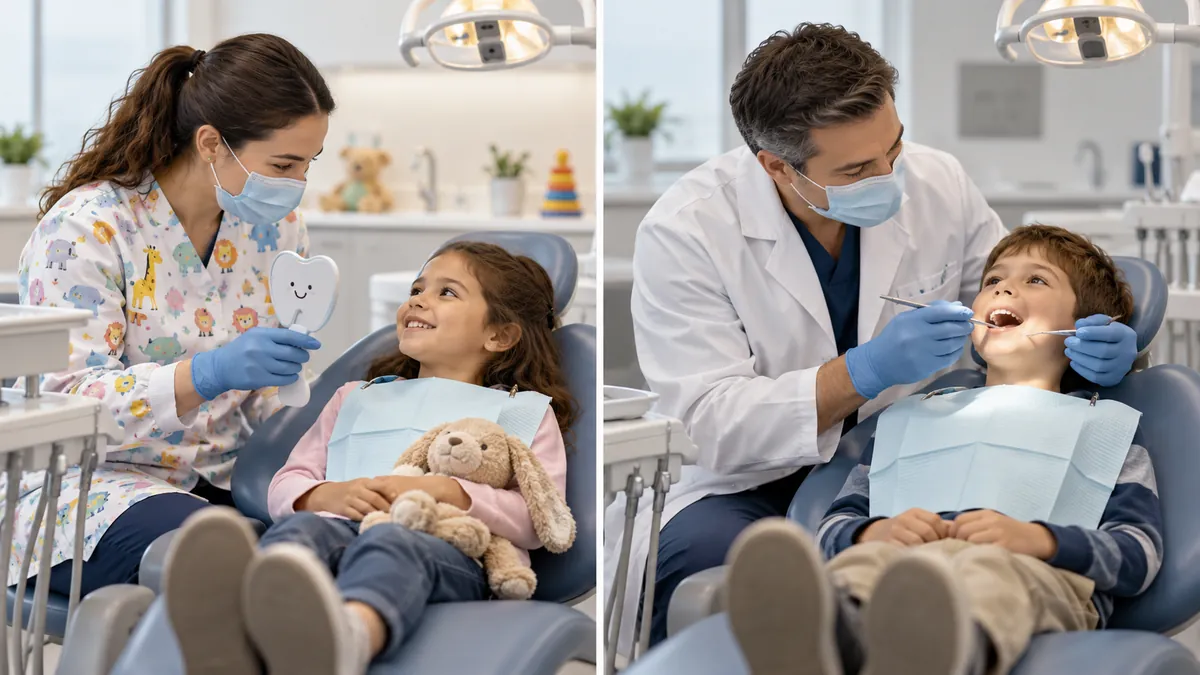
| Dimension | Pediatric dentist | General dentist | What Does This Mean for Suitability? |
|---|---|---|---|
| Professional focus or specialty | The dentist’s work is related to pediatric dentistry, and a formal specialist designation may apply depending on the dentist’s qualifications and approved professional requirements. | The dentist works within the scope of general dental practice, which may include treating children depending on experience and scope of practice. | This dimension becomes more important when the child’s needs require focused experience in a pediatric care context, while the dentist’s actual professional designation should be verified. |
| Experience with children’s age groups | A focus on caring for children and their needs across developmental stages is a core part of the professional context of pediatric dentistry. | The dentist may have varying degrees of experience with children depending on practice and professional experience. | Suitability is evaluated according to the child’s needs and how well the dentist’s experience aligns with the child’s age and developmental stage. |
| Communication and behavior management | Communication with children and behavior management in dental care may be a more prominent part of child-focused experience. | The dentist may use suitable communication and behavior-management approaches according to experience with children and the nature of the practice. | This dimension becomes more relevant when the child needs clear adaptation in communication or handling during the visit. |
| Common suitability context | This option may be more suitable when the child’s needs benefit from focused pediatric dental experience or an approach oriented to developmental stages and working with children. | This option may be suitable for the child’s care when the child’s needs align with the dentist’s experience, capabilities, and available scope of practice. | The choice depends on the child’s needs and the dentist’s actual capabilities, not on a fixed ranking between the two roles. |
The difference between a pediatric dentist and a general dentist helps assess professional suitability for the case, not make a general judgment about the quality of either. When relying on a specialist title or a specific professional designation in Saudi Arabia, the approved professional classification and qualifications should be verified rather than inferred from the clinic name or the nature of the practice alone.
What Criteria Help Evaluate a Dental Clinic’s Suitability for Your Child?
Clinic suitability is assessed by how well the child’s needs align with clinic capabilities that can be observed or verified, and no single criterion is sufficient to establish suitability on its own. These child-specific criteria complement the broader Dental clinic selection criteria rather than replace them.
Evaluation criteria represent dimensions of suitability, not a quality score. Each criterion has a situation connected to the child’s needs, verifiable evidence or an observable indicator in the clinic’s capabilities, and an implication for how well the clinic fits those needs.
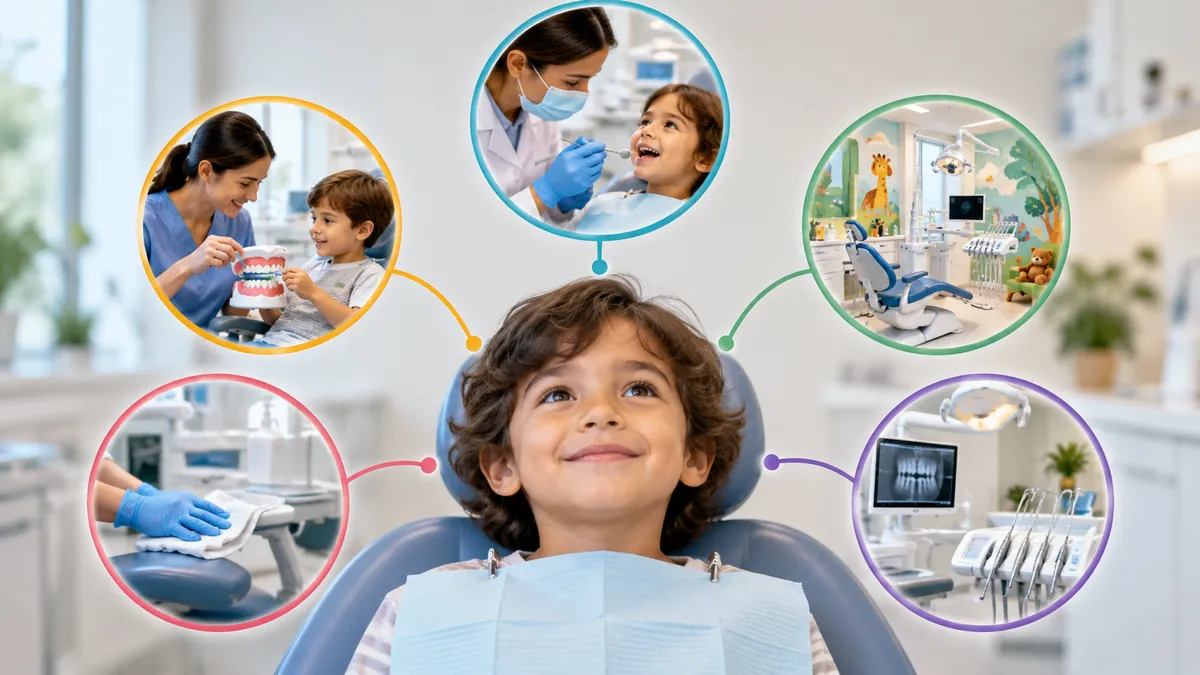
A dental clinic’s suitability for a child can be evaluated across five main dimensions, with each dimension linking a child-specific need to a clinic capability that can be verified:
- Professional suitability: When the child’s needs require specific professional expertise, verifying the dentist’s specialty, qualifications, and scope of practice helps determine how relevant the dentist’s capabilities are to the required need.
- Age-related experience: If the child’s age or developmental stage affects care, relevant experience with that age group is an indicator that contributes to evaluating suitability.
- Communication: When the child needs a communication approach adapted to age or response, the way the team interacts with the child and the parent or guardian provides observable evidence of how well this aspect fits the child’s needs.
- Clinic environment: If the child’s response to the setting affects the visit experience, the clinic environment and the way the team works with the child help estimate how well the environment fits the child’s needs without treating it as an independent judgment of care quality.
- Safety: When the child’s condition or required care involves specific safety considerations, verifying the capabilities and procedures relevant to the situation is more informative than relying on a general description of the clinic.
The meaning of each criterion changes according to the child’s needs and what can be verified in the clinic’s capabilities, so considering these dimensions together supports a suitability assessment without turning any single criterion into a final judgment.
Dentist Specialty and Experience with the Child’s Age Group
Pediatric dentistry is a professional specialty tied to the dentist’s qualifications, which should be verified, while the dentist’s experience with children in the relevant age group is separate practical experience and does not by itself mean formal specialization. Both are verifiable characteristics when assessing how relevant the dentist’s background is to the child’s needs, not standalone evidence of care quality.

The dentist’s experience with the child’s age group may be relevant to the ability to adapt communication, the examination approach, and behavior management to the child’s needs. Practical experience may also help when addressing age-related dental needs. Professional specialization remains distinct from general experience with children, and Dental clinic specialties and departments can be consulted to understand the broader context of specialties without assuming an unverified professional designation. The dentist’s qualifications, relevant experience, and scope of practice should be verified from reliable sources when evaluating suitability. Qualifications and experience remain evaluation characteristics and do not guarantee any specific treatment outcome.
Communication with the Child and Involving the Parent or Guardian
Communication with the child and involvement of the parent or guardian are observable features of the clinic interaction. They include using age-appropriate language with the child and exchanging information with the parent or guardian when appropriate. This aspect is assessed through the way the team explains, listens, and clarifies, not through a friendly impression alone.
Communication can be evaluated through clear behaviors during interaction with the child and the parent or guardian:
- Age-appropriate language: Adapting words and explanations to the child’s level of understanding helps make communication easier for the child to understand.
- Explaining the procedure: Explaining what will happen to the child in an age-appropriate way before the procedure can help the child understand what is happening without assuming a particular outcome for cooperation.
- Listening to the child’s concerns: Paying attention to and listening to the child’s questions and concerns shows how responsive the communication is to what the child expresses during the visit.
- Involving the parent or guardian: Obtaining relevant health information from the parent or guardian and keeping them appropriately informed shows the caregiver-focused side of communication alongside communication with the child.
Together, these behaviors act as indicators of the communication approach and may support understanding or comfort depending on the child’s response and circumstances, but they do not establish the quality of clinical care on their own. Supportive communication and involving the parent or guardian in information exchange also do not by themselves determine formal consent requirements or regulatory obligations, which require an appropriate official reference.
Child-Appropriate Clinic Environment and Equipment
A child-appropriate clinic environment is assessed through functional characteristics that can be observed and compared with the child’s needs, not through decor or an attractive appearance alone. These characteristics include how the waiting area is organized, suitable equipment, management of sensory stimuli, privacy, and how accustomed the staff are to working with children.
These aspects can be examined as practical indicators of how suitable the environment is for the child:
- Waiting area: Organizing the waiting area with children’s use in mind may help make the waiting period more manageable depending on the child’s age and needs.
- Facilities and equipment: The availability of suitable equipment, or equipment that can be adapted to the child’s age and size when relevant, supports practical suitability during the visit without establishing treatment quality by itself.
- Sensory stimuli: Noise levels, lighting, and other sensory stimuli may matter for children who are affected by these factors, with responses varying from one child to another.
- Privacy: An appropriate degree of privacy during assessment or care may help meet the needs of the child and parent or guardian according to the situation.
- Staff experience with children: Staff familiarity with working with different age groups may help adapt the operational and communication aspects of the visit to the child’s needs.
These features may make the environment more suitable for some children’s needs, but they do not automatically mean that the clinic provides higher-quality clinical care or better treatment outcomes.
Safety Considerations Related to the Child’s Age and Type of Procedure
Safety considerations for a child in a dental clinic vary according to the child’s age, health condition, level of cooperation, and type of procedure; no single rule fits every case. Assessing suitability requires professional evaluation of the circumstances related to the child and procedure, together with verification of the relevant clinic capabilities.
Assessment and verification requirements can be organized into three connected categories:
- Child-related circumstances: The child’s age, health condition, and level of cooperation may change what requires professional assessment before a procedure, so safety precautions should be considered based on the child’s actual condition rather than age alone.
- Procedure-related circumstances: The type of procedure determines which related safety requirements may need assessment or verification. A procedure or precaution being suitable in one situation does not mean it is suitable for every child or procedure.
- Clinic capabilities: When the situation requires specific clinic facilities, capabilities, or safety protocols, their availability and suitability for the child’s situation and the procedure should be verified rather than assumed from a general clinic description.
Details related to anesthesia, sedation, infection control, or regulatory requirements require verification from reliable professional or official sources according to the situation, and individualized instructions should not be inferred from them without an appropriate assessment. Safety-related questions can be considered alongside What to check before booking as part of broader factual checks, while keeping the child-specific and procedure-specific evaluation within appropriate professional judgment.
How Can You Evaluate a Clinic’s Handling of a Fearful or Anxious Child?
Parents can evaluate how a clinic handles a child’s fear and anxiety by observing how the team responds to fear or distress, not by expecting the child to remain calm. The assessment includes observing whether age-appropriate communication and adaptation to the child’s level of cooperation reflect a response proportionate to the situation.
The purpose of the following criteria is to interpret observable team behavior, not diagnose the child’s anxiety or predict the outcome of the visit:
- Response to fear: Observing that the team changes its response when the child shows fear or tension may indicate a responsive approach; continued fear or crying alone does not establish poor handling by the clinic.
- Communication and pace: Adapting communication, explanation, and pace to the child’s age and response may indicate consideration of the child’s level of understanding and anxiety; this should be interpreted alongside the actual situation and the child’s cooperation.
- Adapting to limited cooperation: Changing the handling approach when the child’s cooperation is limited may indicate the team’s ability to adapt rather than rely on a single response; it does not mean that the child’s cooperation or emotional state will change.
- Limits of interpretation: Calming measures can be observed as part of the team’s handling, but the child’s response alone is not enough to diagnose anxiety or determine the need for a clinical intervention. These are limits of interpretation and require professional assessment when needed.
Supportive behavioral handling of a child’s fear differs from medication-based sedation or anesthesia because these are clinical interventions and are not an automatic response to anxiety or limited cooperation. Determining the need for any such intervention requires professional assessment appropriate to the child, procedure, and clinical circumstances.
Preparing the Child in the Clinic and Explaining What Will Happen in an Age-Appropriate Way
Preparing the child in the clinic is an adaptive communication approach that helps introduce what is happening in a way that fits the child’s understanding and response. It is not a fixed script applied in the same way to every child. A flexible sequence can be used to organize preparation while adjusting the pace of the visit according to the child’s response.
- Building rapport: The interaction begins with an appropriate amount of communication that helps the child become familiar with the team and setting before moving to what will happen next.
- Age-appropriate explanation: The child is told what needs to be understood in language appropriate to the child’s age, with the next step explained directly and simply.
- Gradual introduction: The child can be introduced gradually to the procedure or unfamiliar elements when appropriate, keeping the explanation connected to what will happen next rather than giving more detail than the child needs.
- Adapting to the child’s response: The child’s response is observed during preparation, and the communication approach or pace of the visit is adjusted when needed rather than treating the sequence as fixed mandatory steps.
How a child is prepared varies according to age, temperament, the nature of the procedure, and the child’s response during the visit, so the order of details or the amount of explanation and gradual introduction may change. Judging the appropriate approach and pace remains tied to professional assessment of the case, while the basic principle is to adapt communication in the clinic to the child’s needs.
Indicators of Appropriate Handling of a Child’s Fear and Anxiety
Indicators of appropriate handling of a child’s fear and anxiety are identified through observable team behaviors, not through the emotional state the child shows during the visit. Observing the interaction helps assess whether the team responds to fear and tension in a way adapted to the situation.
- Calm communication: The team speaks to the child in a calm tone and in a way that matches the child’s level of understanding rather than increasing pressure when fear appears.
- Explaining the procedure: The team explains what will happen before continuing, using age-appropriate language and enough detail to help the child understand the next step.
- Responding to distress: The team notices signs of distress and responds to them rather than ignoring them or continuing in the same way without adjustment.
- Appropriate pace: The team adjusts the pace of interaction or movement between steps when the child’s response indicates a need for more time.
- Involving the parent or guardian: The team involves the parent or guardian in information exchange or communication support when appropriate to the situation and the child’s needs.
- Adaptation: The team changes the explanation or interaction approach when the child’s cooperation is limited rather than sticking to one method despite the child’s response.
These behavioral indicators may support an interpretation that the team responds appropriately to the child’s fear or anxiety, but they do not establish the quality of care as a whole and the clinic should not be judged from a single indicator. They also do not predict the treatment outcome; a calm child does not automatically mean better care, and continued distress alone does not establish poor handling.